



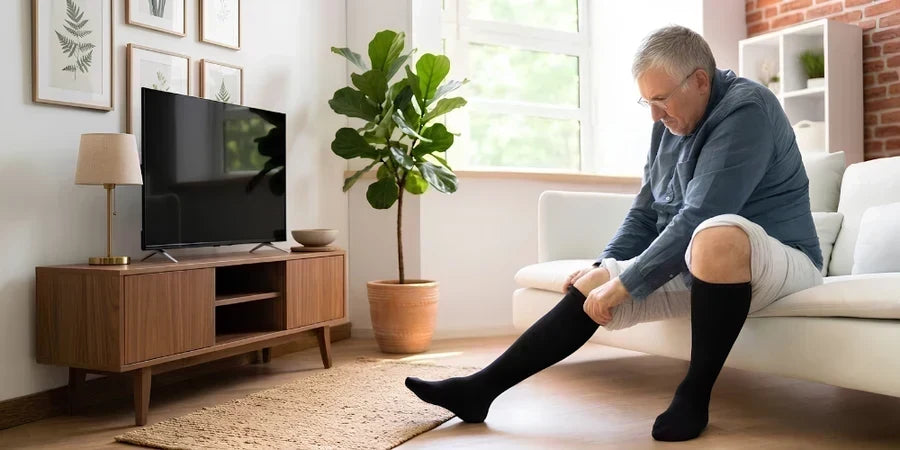
Compression socks come in different styles, lengths and compression strengths, which can make choosing a pair feel more complicated than expected.
One of the first things you may notice when shopping is a pressure range such as 15–20 mmHg, 20–30 mmHg or 30–40 mmHg. These numbers indicate how much pressure the garment is designed to provide, but a higher number does not automatically mean a better choice.
Understanding how graduated compression socks work, what different compression levels mean and why proper fit matters can help you compare your options more confidently.
At a glance
Compression strength is measured in mmHg. Common ranges include 15–20 mmHg, 20–30 mmHg and 30–40 mmHg. Choosing a product should also take fit, intended use and individual needs into account.
What are graduated compression socks?
Graduated compression socks and stockings are designed to apply controlled pressure to the leg. In a graduated design, pressure is generally greatest around the ankle and gradually decreases farther up the leg.
The amount of pressure is measured in millimetres of mercury (mmHg).
A lower compression range commonly available in everyday and over-the-counter styles.
A higher compression range that may also be found in medical compression products.
A higher-compression range where proper fitting and professional guidance may be particularly important.
Compression level is only one part of choosing a product. Fit, garment length, material, intended use and the manufacturer's instructions should also be considered.
What does mmHg mean in compression socks?
mmHg stands for millimetres of mercury, a unit used to measure pressure.
A compression sock labelled 15–20 mmHg, for example, is designed to provide pressure within that range when properly fitted and worn according to the manufacturer's directions.
The numbers make compression strengths easier to compare, but sizing and fit remain important considerations.
15–20 mmHg compression socks
15–20 mmHg compression socks are widely available and commonly found among everyday and over-the-counter compression styles.
People considering this range may be looking for compression hosiery that fits into daily routines involving work, travel or extended periods of sitting or standing.
Common styles include:
- Knee-high compression socks
- Casual and everyday styles
- Dress socks
- Athletic-inspired designs
- Open-toe and closed-toe options
Check the manufacturer's sizing chart carefully rather than choosing based only on shoe size. Depending on the product, ankle and calf measurements may be required.
20–30 mmHg compression socks
20–30 mmHg compression socks provide more pressure than 15–20 mmHg products.
Some products within this range may be designed for more specific compression needs. If compression is being considered because of a medical condition, ongoing symptoms or a healthcare recommendation, professional advice may be appropriate.
Accurate measurement is particularly important because compression hosiery that is incorrectly sized may not fit or perform as intended.
30–40 mmHg compression socks
30–40 mmHg compression represents a higher compression range.
Higher compression should not be selected simply because it provides more pressure. The appropriate level depends on the individual, intended purpose and specific product.
Important: If higher-compression hosiery has been recommended by a healthcare professional, follow their guidance together with the manufacturer's fitting and wear instructions.
Browse medical compression socks and stockings
15–20 vs. 20–30 mmHg: what is the difference?
The main difference between 15–20 mmHg and 20–30 mmHg compression socks is the amount of pressure the garment is designed to provide.
| Feature | 15–20 mmHg | 20–30 mmHg |
|---|---|---|
| Pressure | Lower range | Higher range |
| Product types | Common in everyday and OTC styles | Available across a range of compression products |
| What to consider | Intended use, measurements, product instructions and professional guidance where appropriate. | |
A higher compression range is not automatically the better option. The appropriate choice depends on why the garment is being worn and how the product is intended to be used.
Medical compression vs. OTC compression socks
OTC compression
Over-the-counter compression products are available without a prescription and come in a variety of compression strengths, fabrics, lengths and everyday styles.
Medical compression
Medical compression hosiery may be intended for more specific compression requirements and is available in different strengths, lengths and designs.
Compression socks for swelling
People often consider compression socks when experiencing swelling in the feet, ankles or legs.
Swelling can have many causes, however, so a compression level should not be selected based on swelling alone.
If swelling is new, unexplained, persistent or significant, speak with a qualified healthcare professional before choosing compression hosiery for that purpose.
Compression socks and varicose veins
Compression socks are also commonly considered by people with varicose veins.
Because symptoms and individual needs vary, the appropriate type and compression level will not be the same for everyone.
Avoid choosing higher compression simply because symptoms appear more noticeable. Professional guidance can help determine whether compression hosiery is appropriate for your circumstances.
Compression socks for travel
Long trips can involve several hours of sitting, which is one reason travellers often consider compression socks.
When comparing compression socks for travel, consider comfort, fit, material and the manufacturer's sizing measurements.
People with an existing health condition or concerns about circulation should seek professional advice before using compression hosiery for travel.
Are diabetic socks the same as compression socks?
No. Diabetic socks and compression socks are designed differently and should not automatically be considered interchangeable.
Diabetic socks commonly focus on comfort-related features such as cushioning, minimal seams and non-binding construction. Compression socks, in comparison, are designed to provide measured pressure.
How to choose compression socks
Consider your intended use
Think about whether you are looking for everyday compression, a travel option or a product recommended for a specific reason.
Check the compression level
Review the mmHg range together with the manufacturer's product information.
Measure carefully
Compression hosiery may require ankle, calf or other leg measurements rather than relying only on your regular shoe size.
Consider the length
Compression hosiery is available in knee-high and longer styles. Choose according to the product's intended use and any guidance you have received.
Think about everyday comfort
Fabric, toe design, top band and ease of putting the garment on can all affect how comfortable it is to wear.
Frequently asked questions
What does 15–20 mmHg mean in compression socks?
Is 20–30 mmHg stronger than 15–20 mmHg?
Should I choose the strongest compression socks available?
Can I wear compression socks every day?
How do I know what size compression socks I need?
Are diabetic socks the same as compression socks?
Understanding your compression options
Understanding the difference between 15–20, 20–30 and 30–40 mmHg compression socks is a useful starting point.
Compression strength matters, but so do proper sizing, garment length, comfort and intended use. The strongest option is not necessarily the right one.
Find compression hosiery that fits your needs
Explore OTC and medical compression options available at Wellwise®.
Shop Compression HosieryThis article is for general educational information only and is not a substitute for professional medical advice, diagnosis or treatment. Always follow the manufacturer's product information and consult a qualified healthcare professional if you have questions about whether compression hosiery is appropriate for you.


